
Finnish Spitz Health
The Finnish Spitz is, by both reputation and data, a hardy and generally healthy breed. As a primitive northern dog shaped over thousands of years as a working hunter, it carries comparatively few widespread inherited problems. The Finnish Spitz Club of America’s official health statement says it plainly: the breed is generally healthy, with no health issues consistent throughout the breed in the United States.
This page is general education for owners, breeders, and anyone considering the breed — it is not veterinary advice. Always consult your own veterinarian and your dog’s breeder.
Lifespan & general profile
Most Finnish Spitz live roughly 12–14 years. Kennel-club survey and pet-insurance data from the Nordic countries — where the breed is most numerous — place the median a little lower, around 11–13 years, with dogs that reach natural old age often living to 13½ or beyond. Keeping a Finnish Spitz lean, fit, and mentally engaged is the single most valuable thing an owner can do for a long, healthy life.
Recommended health screening
The FSCA does not mandate any specific health test. Instead it encourages breeders to screen for problems that may appear in their lines, and recognizes those who do. The commonly recommended voluntary panel for breeding dogs is:
- Hips — OFA hip evaluation (X-ray)
- Elbows — OFA elbow evaluation (X-ray)
- Patellas (knees) — OFA patella evaluation (hands-on exam)
- Eyes — exam by a veterinary ophthalmologist (OFA/CAER)
In Finland, the breed’s homeland, patella and eye examinations are effectively required to register breeding dogs — a useful benchmark even where U.S. testing is voluntary. Prospective puppy buyers should ask to see a breeder’s screening results; responsible breeders share them freely and often post them publicly on the Orthopedic Foundation for Animals website (ofa.org).
Conditions to understand
No breed is entirely free of health concerns. The conditions below are the ones most worth knowing — most are uncommon or mild in Finnish Spitz, and several have grown rarer thanks to careful breeding.
Patellar luxation (slipping kneecap). The best-documented orthopedic issue in the breed, though still uncommon and usually mild. The kneecap briefly slips out of its groove, causing an occasional skip or hitch in a hind leg. Nordic screening finds the large majority of dogs normal. Detected by a simple hands-on exam.
Hip & elbow dysplasia. Malformations of the hip or elbow joint that can lead to arthritis. Both are screened by X-ray, but neither is a widespread problem in this small, light breed, and clinical impact is generally low. Screening is still recommended for breeding stock.
Epilepsy — a breeding success story. Inherited epilepsy (recurring seizures with no other cause) was historically the breed’s most notable concern. Through careful, pedigree-based selection using an “epilepsy index,” Nordic breeders reduced its frequency dramatically over the past two decades. There is no DNA test yet, so responsible breeding still depends on knowing a dog’s family history.
Eye conditions. Periodic eye exams by a veterinary ophthalmologist are the best safeguard. The conditions documented in the breed are cataracts (about 1 in 20 examined dogs) and a congenital blood-vessel remnant called PHTVL/PHPV (about 1 in 40). Progressive retinal atrophy (PRA), which some general sources mention, is not well documented as a significant problem specific to Finnish Spitz.
Diabetes mellitus. Northern spitz breeds carry a modestly elevated risk of diabetes, which typically appears in older dogs and affects only a small minority. There is no pre-breeding test; the best prevention is keeping your dog lean for life. In a senior dog, watch for increased thirst, urination, or appetite changes and consult your veterinarian.
Before you fall in love: the barking trait
The one “trait” every prospective owner must understand isn’t a health problem at all — it’s the breed’s defining feature. The Finnish Spitz is the “Barking Bird Dog,” bred to find game birds and bark to hold them for the hunter, at a rate that can approach 160 barks a minute. In Finland, a dog must demonstrate its voice to earn a conformation championship. Finnish Spitz are devoted, wonderful companions — but they are genuinely vocal dogs. Anyone in an apartment or with close neighbors should go in with eyes (and ears) open.

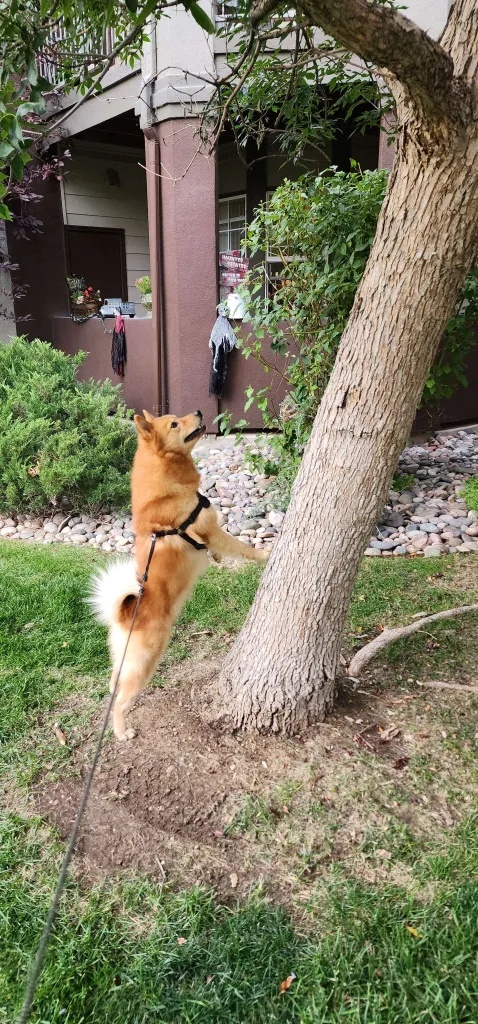
Living with a Finnish Spitz
Coat & grooming. A weather-resistant double coat that’s low-maintenance most of the year — a weekly brushing keeps it healthy — but “blows” heavily twice a year, when daily brushing helps. Never shave a Finnish Spitz; the coat insulates against both cold and heat.
Temperament & exercise. Intelligent, lively, and independent-minded, with a strong hunting instinct. They thrive on daily exercise and mental stimulation, bond closely with their families, and are known for being good with children. Positive, varied training works far better than repetition, and a secure yard and reliable recall matter given the breed’s prey drive.
Weight. Keep them lean — it protects the knees and joints and lowers the late-life diabetes risk.
For breeders
Test what runs in your lines — the recommended panel is hips, elbows, patellas, and eyes — know your pedigrees (especially for epilepsy, where family history remains the main tool), and prioritize genetic diversity. Please report health problems and longevity back to the club’s health efforts: the breed’s excellent health record is maintained only when breeders and owners share honest information.
Sources
This overview draws on the Finnish Spitz Club of America’s official health statement, Nordic kennel-club and pet-insurance screening data, and general veterinary guidance. For screening records and breed statistics, see the Orthopedic Foundation for Animals (ofa.org). It is educational only and does not replace advice from your own veterinarian.